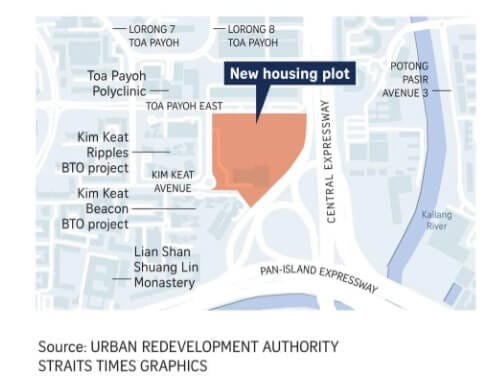
Two D13 addresses. Both listed as “near a primary school.” Similar price range.
One sits within 1km of a school where Singapore Citizens actually had to fight a ballot in 2026’s Phase 2C. The other sits within 1km of a school where every single applicant got in, no ballot needed.
Same listing pitch. Completely different P1 outcome.
“Within 1km” isn’t the advantage. It just puts you in the queue. Whether that queue was ever a real fight is a separate question, and most listings never answer it.
The real question: 1km of which school, and did that school’s applicants actually have to fight for a place?
MOE just made that question matter more. It changed the Primary 1 registration framework on 10 September 2026. What that means for District 13 specifically is below.
First, the numbers: I matched 2026 Phase 2C demand against OneMap’s official school-distance bands, address by address.
This is a data piece, not an opinion piece.
First, what actually changed?
MOE’s 10 September announcement makes two changes, effective from the 2027 exercise (children starting P1 in 2028):
- Phase 2C reserved places double from 40 to 60 at every school with 180 or more total P1 places. Smaller schools keep 40. The extra seats come out of the earlier phases, so the connected/affiliated pool shrinks slightly at affected schools.
- A new two-track scheme applies at 12 schools nationwide where public housing makes up less than 40% of homes within 2km, mostly established schools like ACS, Nanyang Primary, and Raffles Girls’. None are in District 13.
D13 buyers don’t lose the home-distance advantage the way buyers near those 12 schools partly will. But D13 schools with 180+ places still see their Phase 2C seats rise from 40 to 60 from 2027, which changes the math for families without a prior school connection.
Separately, MOE is also cutting P1 intake nationally due to falling birth cohorts, about 1,460 fewer places overall. Maris Stella bucked that trend, up from 270 to 330, as it turns co-ed from 2027. Girls became eligible to apply starting the 2026 exercise itself, the same round behind the numbers below. More on what that means for property in my separate guide, including one detail most people miss: MOE still measures distance from the permanent Mount Vernon Road site, not the temporary holding campus, throughout the rebuild. Sources: MOE, 2026 Primary One Registration Exercise; Mothership, 10 Sept 2026; AsiaOne, 10 Sept 2026.
The 1km rule only matters when there’s a fight for places
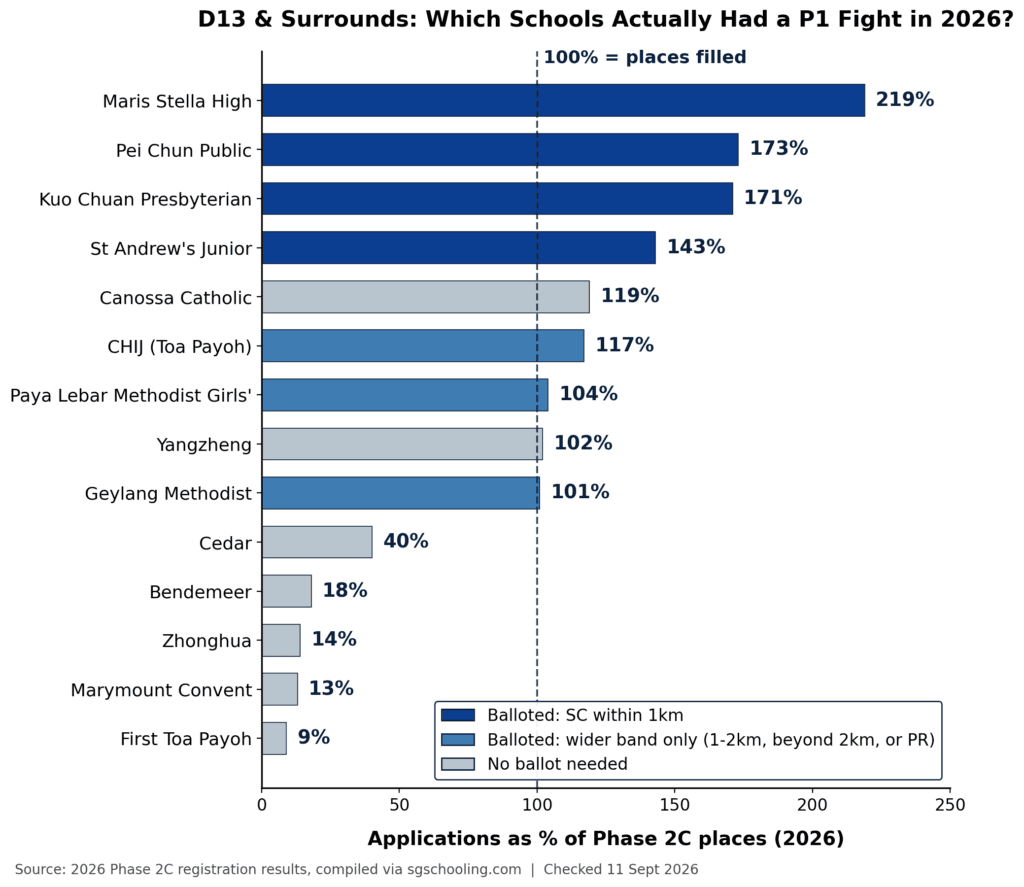
It’s the same kind of gap between what’s commonly repeated and what the data actually shows that I went through in 5 Singapore property myths, busted by real numbers. Here’s the real 2026 Phase 2C data for the schools relevant to D13 and its immediate surrounds:
| School | Phase 2C Places | Applications | Applications / Places | 2026 Outcome |
|---|---|---|---|---|
| Maris Stella High | 75 | 164 | 219% | Balloted, SC within 1km |
| Pei Chun Public | 44 | 76 | 173% | Balloted, SC within 1km |
| Kuo Chuan Presbyterian | 48 | 82 | 171% | Balloted, SC within 1km |
| St Andrew’s Junior | 70 | 100 | 143% | Balloted, SC within 1km |
| Paya Lebar Methodist Girls’ | 99 | 103 | 104% | Balloted, SC even beyond 2km |
| CHIJ (Toa Payoh) | 64 | 75 | 117% | Balloted, SC 1-2km |
| Canossa Catholic | 42 | 50 | 119% | All admitted, no ballot |
| Yangzheng | 55 | 56 | 102% | All admitted, no ballot |
| Cedar | 141 | 57 | 40% | No ballot |
| First Toa Payoh | 125 | 11 | 9% | No ballot |
| Bendemeer | 134 | 24 | 18% | No ballot |
| Zhonghua | 126 | 18 | 14% | No ballot |
| Marymount Convent | 210 | 27 | 13% | No ballot |
| Geylang Methodist | 149 | 151 | 101% | Balloted, PR beyond 2km only |
Four schools in this D13 analysis actually had Phase 2C balloting among Singapore Citizens within 1km in 2026: Maris Stella High, Pei Chun Public, Kuo Chuan Presbyterian, and St Andrew’s Junior. Paya Lebar Methodist Girls’ is worth flagging separately, since its ballot pressure was so high that even applicants beyond 2km still had to compete.
Canossa Catholic and Yangzheng both look like exclusive, hard-to-reach schools on a map. Neither one actually forced a fight in 2026. Cedar, First Toa Payoh, Bendemeer, Zhonghua, and Marymount Convent all had room to spare.
Source: 2026 Phase 2C results, sgschooling.com, compiled from official MOE Primary 1 registration data.
Why OneMap, not Google Maps or a listing
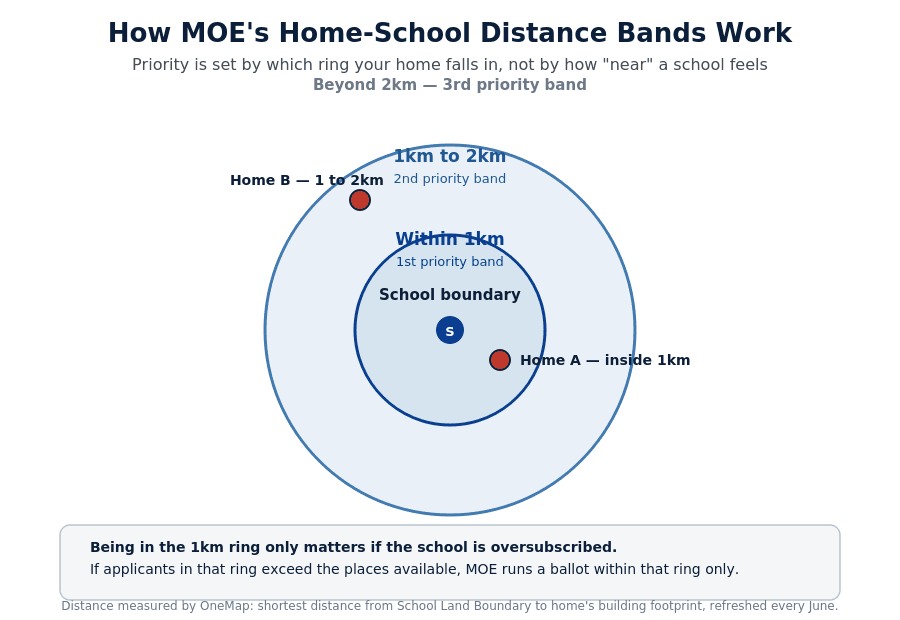
Every distance figure in this article comes from OneMap SchoolQuery, maintained by the Singapore Land Authority. MOE has confirmed in Parliament that OneMap’s distance measurement is the official one used for P1 balloting, not a walking route, not a straight pin-to-pin line, and not whatever a listing claims.
Two details matter here:
- Home-school distance is calculated as the shortest distance from the School Land Boundary to the home’s building footprint, so two nearby-looking properties can land in different distance bands depending on exact building outlines.
- This data is refreshed annually every June. A property inside 1km today is not a permanent guarantee for a child registering in a future year.
All figures below were checked on 11 September 2026.
The D13 property matrix
Checked against OneMap SchoolQuery on 11 September 2026. “Within 1km” schools are the ones that matter for first-priority distance; “within 1-2km” is the second-priority band.
The Tre Ver Within 1km: St Andrew’s Junior, Pei Chun Public, First Toa Payoh Within 1-2km: Maris Stella High, Cedar, Bendemeer, Yangzheng
Woodleigh Glen Within 1km: Maris Stella High, Cedar, Yangzheng Within 1-2km: St Andrew’s Junior, Pei Chun Public, Canossa Catholic, First Toa Payoh
Bartley Ridge Within 1km: Maris Stella High, Cedar Within 1-2km: St Andrew’s Junior, Canossa Catholic, Yangzheng
Oasis Garden Within 1km: Maris Stella High, Cedar Within 1-2km: Canossa Catholic, Yangzheng
MacPherson Garden Estate* Within 1km: Cedar, Canossa Catholic Within 1-2km: Maris Stella High, St Andrew’s Junior
Sennett Estate* Within 1km: Cedar, Canossa Catholic Within 1-2km: Maris Stella High, St Andrew’s Junior, Bendemeer
The Venue Residences Within 1km: St Andrew’s Junior, Cedar, Bendemeer Within 1-2km: Maris Stella High, Pei Chun Public, Canossa Catholic, First Toa Payoh
Leicester Lodge Within 1km: St Andrew’s Junior, Bendemeer Within 1-2km: Maris Stella High, Pei Chun Public, Cedar, Canossa Catholic, First Toa Payoh, Yangzheng
Avon Park Within 1km: Maris Stella High, St Andrew’s Junior, Cedar, Yangzheng Within 1-2km: Pei Chun Public, Canossa Catholic, Bendemeer, First Toa Payoh
*MacPherson Garden Estate and Sennett Estate are landed housing estates, not single-address condos. These figures reflect one specific house near each estate’s outer boundary, not the estate as a whole. Distance bands can shift meaningfully from one house to another within the same estate, so treat these two as one data point at the estate’s edge, not a blanket result for every home in it.
Reading the matrix: three worked examples
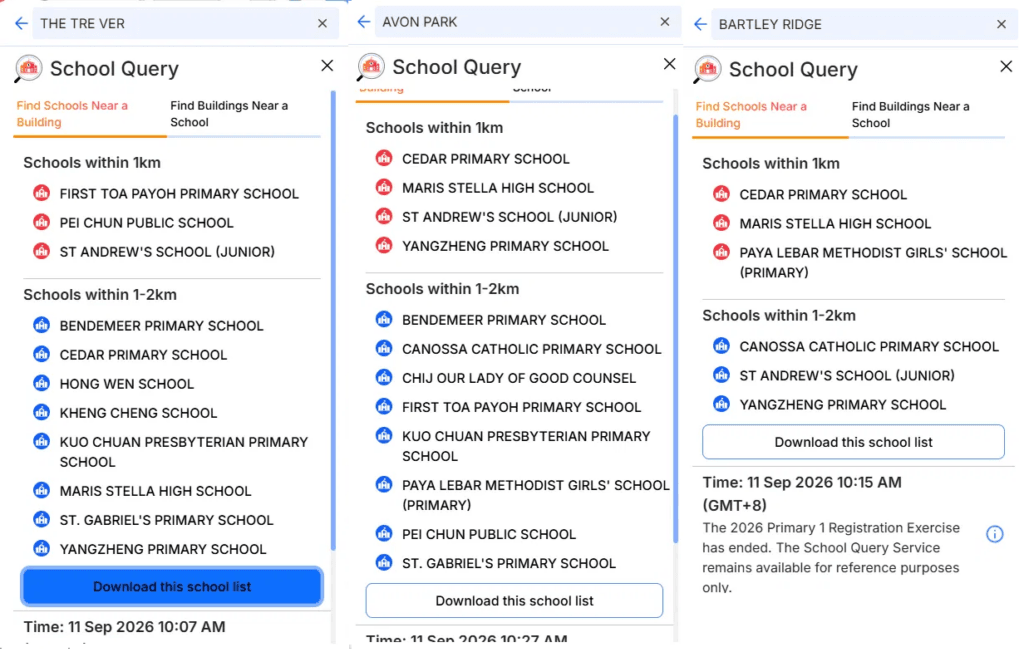
Avon Park is within 1km of both Maris Stella (164 applicants for 75 places) and St Andrew’s Junior (100 applicants for 70 places). Both actually balloted Singapore Citizens within 1km in 2026, a genuine two-school 1km advantage.
The Tre Ver matches that same profile from the other side of D13. It’s within 1km of both St Andrew’s Junior and Pei Chun Public, both balloted in 2026. Its closest school by reputation, Maris Stella, actually sits at 1-2km from this address, not 1km, easy to miss if you’re going by a listing rather than an OneMap check. Avon Park and The Tre Ver are the only two properties in this set with a genuine two-school 1km advantage.
MacPherson Garden Estate and Sennett Estate are the cautionary example, with one caveat: both are landed estates, and the figures here are from a single house sitting near each estate’s outer boundary, not a representative check of the whole estate. Even with that caveat, the pattern holds for that specific address: it’s within 1km of both Cedar and Canossa. On paper, “two primary schools within 1km” sounds like a strong pitch. In practice, Cedar had 57 applicants for 141 places, and Canossa admitted every Singapore Citizen within 2km without a ballot. Being within 1km offered no additional ballot advantage in 2026, because neither school required a ballot among those applicants. A house closer to the estate’s centre could land in different bands entirely, so anyone actually living in either estate should run their own exact address through OneMap rather than relying on this row.
D13 is not the school map
MOE doesn’t check which URA district a school sits in. It checks the distance between your exact address and the school’s boundary. That means a District 13 property’s real school options aren’t confined to District 13 at all.
The clearest example in this data: Geylang Methodist School, which is in District 14, shows up within the 1-2km ring for both MacPherson Garden Estate and Sennett Estate. Kuo Chuan Presbyterian (District 20, Bishan), Paya Lebar Methodist Girls’ (District 19, Hougang, despite the name), and CHIJ Our Lady of Good Counsel (District 19, Serangoon Gardens) all show up in the wider radius for several D13 addresses too.
So the right question was never “what schools are in District 13.” It’s “what schools are within 1km and 2km of this exact address,” regardless of which district that turns out to be.
One important limitation
This analysis tells you where the 2026 advantage existed. It cannot tell you what the ballot will look like when your own child registers. School intake can change, demand can change, boundaries can change, and OneMap is refreshed annually. A property safely within 1km today does not come with a guaranteed P1 place years later.
The tier summary
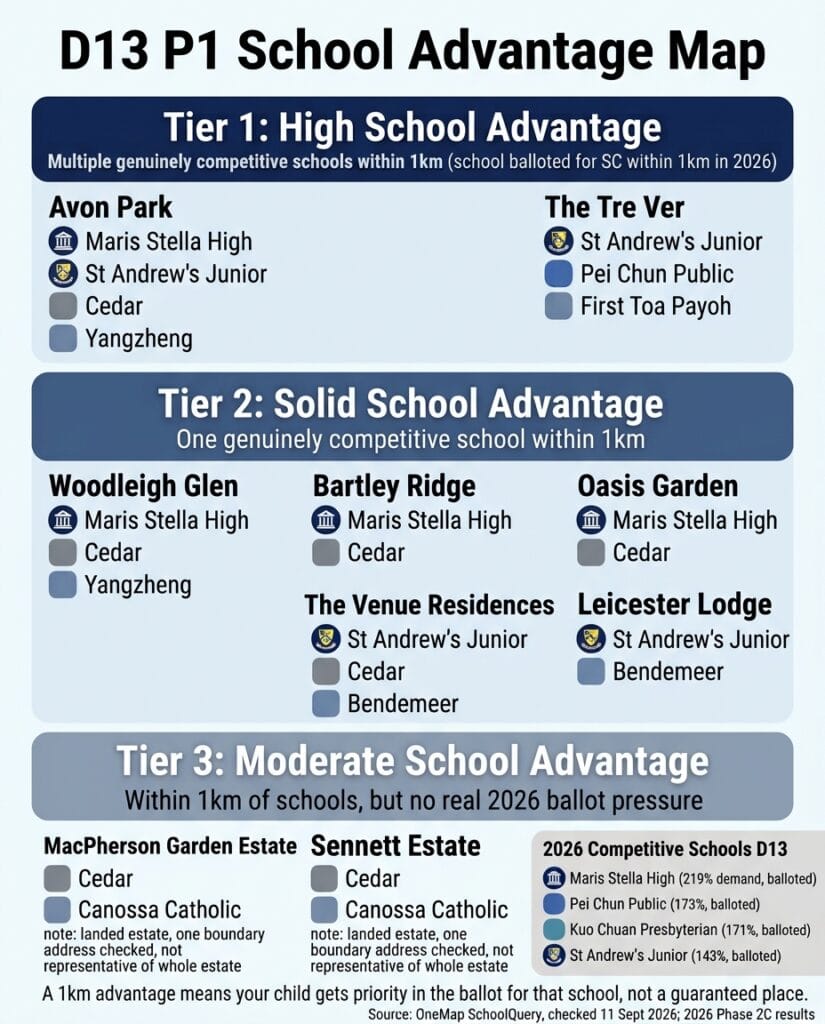
This isn’t a ranking of which property is the better buy overall. It’s a ranking of which property’s school-distance advantage is actually backed by demand.
“Within 1km” is not the advantage. Being within 1km of a school that actually needs the 1km priority is the advantage.
What this means for different buyers
You want the broadest school flexibility, and haven’t settled on one school yet. Look at Avon Park or The Tre Ver. They’re the only two properties in this set within 1km of two schools that both genuinely balloted in 2026, Avon Park via Maris Stella and St Andrew’s Junior, The Tre Ver via St Andrew’s Junior and Pei Chun Public. That’s the closest thing to hedging your bets that this data supports.
You have a son, or expect to. Maris Stella High is the stronger demand driver of the two schools, and St Andrew’s Junior remains boys-only with no announced change. Prioritise properties within 1km of either: Avon Park, Woodleigh Glen, Bartley Ridge, Oasis Garden (Maris Stella), or The Tre Ver, The Venue Residences, Leicester Lodge (St Andrew’s Junior).
You have a daughter. This one needs an update: Maris Stella stopped being boys-only with the very registration cycle behind this data. Girls became eligible to apply starting the 2026 P1 exercise (entry January 2027), so the 164 applicants for 75 places already includes girls. St Andrew’s Junior remains boys-only with no announced change. So for a daughter, Maris Stella is back on the table, alongside Pei Chun Public (1km from The Tre Ver) and Kuo Chuan Presbyterian.
You’d rather avoid the ballot fight entirely. There’s nothing wrong with prioritising certainty over prestige. Cedar, First Toa Payoh, and Marymount Convent all had spare capacity in 2026. A property inside 1km of one of these gives your child a real seat with far less registration-day stress, even if the school doesn’t carry the same name recognition.
You already live in D13 and just want to know your own odds. Don’t extrapolate from any property in this article, including the two landed-estate examples. Run your own exact address through OneMap SchoolQuery. A few hundred metres can shift your result from one distance band to the next.
You’re evaluating this as an investment angle, not just for your own child. Properties backed by real, repeated ballot demand (Tier 1 and Tier 2 above) make a more durable resale pitch than properties near schools that merely sound prestigious. Reputation without demand data is a weaker story to tell the next buyer than “within 1km of a school that’s balloted four years running.” If you’re weighing a new launch specifically, this connects to the pricing logic I laid out in how to know if a new launch is overpriced.
Want your own property checked against this data?
I track District 13 school zones and transaction data as part of my work here, not as a one-off blog post. If you want to know exactly where your unit or a specific project sits against these school boundaries, get your D13 Asset Health Check and I’ll pull the real numbers, not estimates.
What to check before you rely on any of this for your own address
- Your exact address, not the project name.
- The exact school you’re checking against.
- The current OneMap SchoolQuery distance band for that specific pairing.
- That school’s recent Phase 2C demand history, not just its reputation.
- Whether that school has actually balloted in recent years, and for which citizenship and distance group.
- That none of this is fixed. Boundaries, intake, and demand all shift year to year, and OneMap refreshes every June.
Data note: property-to-school distance bands checked using OneMap SchoolQuery on 11 September 2026. School demand figures are from the official 2026 Phase 1 Registration Exercise, Phase 2C results. For MacPherson Garden Estate and Sennett Estate, figures reflect one house near each estate’s boundary, not the estate as a whole; specific addresses are withheld. A property within 1km today is not a guarantee of admission in a future registration exercise.
Sources verified: MOE, 2026 Primary One Registration Exercise Mothership, P1 Registration Framework changes, 10 Sept 2026 AsiaOne, two-track scheme announcement, 10 Sept 2026 OneMap SchoolQuery, Singapore Land Authority MOE Parliamentary reply on OneMap’s official status 2026 Phase 2C results, sgschooling.com MOE SchoolFinder, Maris Stella High School (Primary)