The Singapore property market energy impact is real — but not in the way the headlines are telling you. In March 2026, someone bought a two-bedroom at Pinery Residences in Tampines. 624 sqft. S$2,464 psf. Total ticket: S$1,538,000. They did this while energy shock news was everywhere. They did not flinch, they did not wait for the dust to settle. And they were not alone. According to Urban Redevelopment Authority (URA) data, 1,300 new private homes were sold that month — a 78.3 percent jump from the same time last year. So here is the real question: why are people buying more, not less, when everyone is talking about rising costs?
Singapore Property Market Trends: Fear vs. What Is Actually Happening on the Ground
The Singapore Property Energy Impact on Construction Costs Is Real
Let me be straight with you. The concern about energy prices hitting construction costs is not made up. Singapore’s wholesale trade makes up roughly 19 percent of GDP, and bunkering alone is about 5 percent of total exports, according to The Straits Times. When oil and gas prices spike, everything downstream gets more expensive — cement, steel, crane fuel, transport. The Building and Construction Authority’s (BCA) Tender Price Index was already at 139.0 in Q2 2025, up 42 percent from 98.0 back in 2016, per BCA published data at bca.gov.sg. That was before the Iran conflict added fresh pressure on energy markets. Developers building new projects today are working with a cost base that is significantly more expensive than it was five years ago. That cost does not disappear. It gets passed to you, the buyer, in the next launch price.
So Why Are People Buying More, Not Less?
Here is where it gets interesting. Wong Shanting, director and head of research at Newmark, noted that March’s jump reflected genuine, healthy home-buying appetite — not just a rebound off February’s quiet period. The Singapore property market energy impact narrative being pushed by CNA and The Straits Times frames rising costs as a reason to pause. But the buyers in March read the same news and came to the opposite conclusion: if costs are going up, lock in now before they do.
Analyzing the Singapore Property Market Surge in March 2026
Which Projects Moved and Why It Matters
Two launches did most of the heavy lifting in March. River Modern in River Valley — 455 units, Core Central Region. Pinery Residences in Tampines — 588 units, Outside Central Region. Between them they drove 87 percent of the month’s activity, per URA data compiled by ohsem.me (April 16, 2026). The OCR segment alone moved 665 units, or 51 percent of total March sales. Even the executive condo (EC) segment joined the party — Rivelle Tampines shifted 410 out of 411 EC units at S$1,900 psf and above, per The Straits Times. These were not desperate sellers chasing any buyer they could find. These were well-priced projects in good locations that cleared fast because buyers showed up ready to commit.
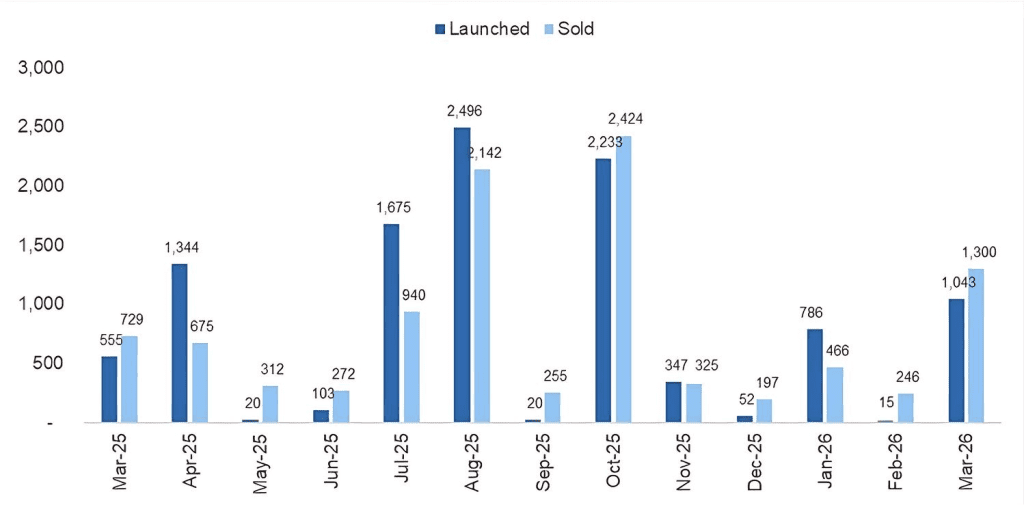
Now, some commentators are pointing to Q1 2026 being down 40.4 percent year on year and calling it a slowdown. That comparison is misleading. Q1 2025 was an unusually strong quarter — mortgage rates had just fallen sharply and pent-up demand came flooding in all at once. Measuring March 2026 against that peak is like comparing a regular Saturday crowd to a one-off sale event. March 2026 on its own terms shows a market with real legs.
Front-Running the Singapore Property Market Energy Impact on Future Launch Prices
The Singapore Property Energy Impact Is Narrowing Your Window to Buy
Think about it this way. A developer who breaks ground today is locking in construction contracts in a market where the BCA Tender Price Index has risen 19 percent in just four years — from 117.1 in 2021 to 139.0 by Q2 2025. Add an energy shock on top of that, and the next wave of launches simply cannot be priced where today’s launches are. The developers will not absorb that margin squeeze. They never do.
What the Pipeline Looks Like From Here
There is no shortage of new supply coming. According to 99.co, Tengah Garden Residences has 860 units, Vela Bay has 515, and Hudson Place Residences has 327 — with booking dates running through April and May 2026. These projects were planned and land-bid before the current energy disruption hit. Their actual construction costs, though, will be settled in a more expensive environment. The buyer who moved in March at S$2,464 psf got ahead of that adjustment. Buyers in the next wave will be paying for it.
What to Watch: Three Signals That Will Tell You If This Thesis Holds
The Singapore property market energy impact story is still unfolding. Here are the three things worth tracking over the next two quarters.
One. The URA Private Residential Property Index (PPI) final Q1 2026 reading drops on April 24. Landed home prices already dipped 1.8 percent in Q1 flash estimates, reversing the 3.4 percent gain from Q4 2025, per The Straits Times. If the final number confirms broader softening, the urgency argument takes a hit.
Two. MAS credit data on mortgage drawdowns. If approvals are rising while prices soften, that confirms buyers are moving early and deliberately — not reacting emotionally to headlines.
Three. The HDB Resale Price Index. HDB resale prices fell 0.1 percent in Q1 2026, the first dip in close to seven years, per HDB data at hdb.gov.sg. If that softening continues, the upgrader pipeline feeding private new launches starts to thin out.
What This Means For You, Specifically
If you are sitting on the fence as a buyer. The March data is not hype — it is 1,300 actual transactions. A two-bedroom at Pinery cleared at S$2,464 psf. The next generation of launches will be priced against a higher cost base. Pick one project, stress-test your financing, and decide this quarter. Waiting is also a decision, and it has a price.
If you already own private property. Energy-shock pressure on new supply margins is actually good news for your existing asset. Less margin headroom for developers means less aggressive new pricing that could undercut resale values. But do not assume you are automatically protected. Check what is launching in your district and how it stacks up against your resale price before you decide to hold or sell.
If you are watching the HDB resale market. That 0.1 percent Q1 price dip is a single data point. It is not a trend yet. Do not make a major financial decision based on one quiet quarter. Wait for Q2 HDB RPI data. If it shows a second consecutive dip, then you have something to act on.
The Singapore property market energy impact is not a reason to panic, and it is not a reason to ignore what is happening. It is a reason to understand the direction costs are heading and get ahead of it — the same way 1,300 buyers did in March before the headlines caught up.
For more Singapore real estate insights, visit my blog page
Andy Seng (R058286J) has been advising Singapore homeowners and investors across HDB and private residential property since 2018.