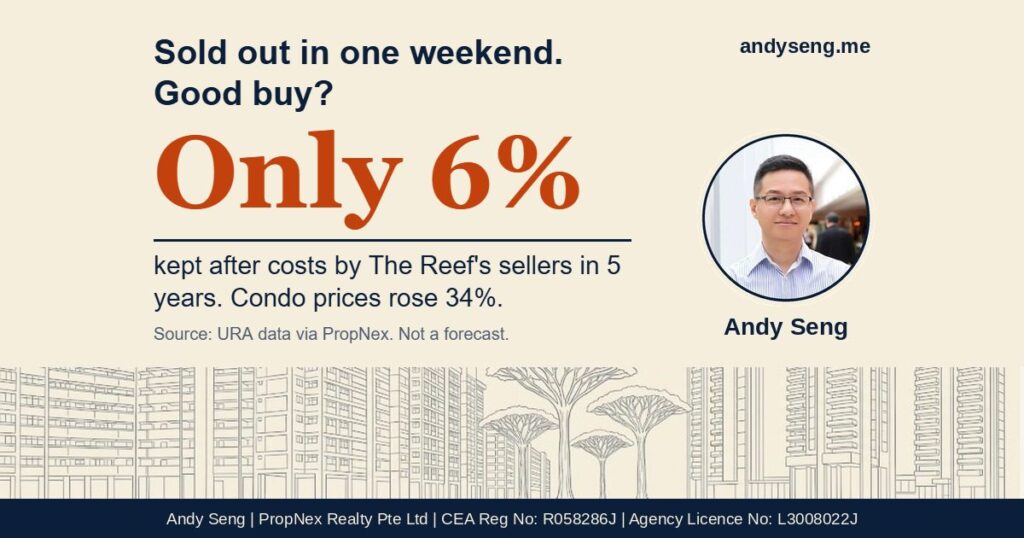
The Reef at King’s Dock sold out in a weekend in 2021. Five years later, its sellers kept about 6% after costs while condo prices rose 34%. Here is what 350 real URA records say before you buy a new launch in 2026 or 2027.
In January 2021, The Reef at King’s Dock sold 280 of the 300 units it released in a single weekend. Crowds, cheques, the works.
Five years later, I checked what those buyers actually made when they sold. After stamp duty and agent fees, the typical seller walked away about 6% richer. Not 6% a year. 6% in total, over about five years.
In the same five years, Singapore condo prices rose about 34%.
That gap is what this article is about. If you bought into a popular launch this year, or you are looking at one in 2027, I think you should see these numbers before you sign anything.
The short version
- A sold-out weekend doesn’t mean a good buy. A launch that sold only a third of its units on day one did better than one that sold 93%.
- The price you pay decides your profit. Owners sold at similar prices, whatever they paid. Pay more, keep less. Small units did worst.
- The market did the heavy lifting. Prices rose 34%, yet after fees, taxes and interest, only 2 of 6 projects kept 10% or more.
- Everything that lifted prices is now at a high. Condo prices, stock markets, land prices, cheap loans and launch prices.
- Time is your best friend. A 2026 buyer selling in year 4 needs prices to rise about 25% to keep a tidy 10%. Since 2009, that happened about 1 in 4 times. Over 8 years, about 1 in 2, and prices never ended lower.
Bottom line: buy a new launch only if you can hold it for 8 years or more, and your price is close to what nearby nearly-new condos actually sell for. Otherwise, you may be placing a bet, not buying a home.
Want to see how I got there? Read on. Every number comes from URA data you can check yourself.
What I looked at
I picked six of the most talked-about launches of 2021 and 2022. For each one, I pulled the real records of owners who bought from the developer and later sold: what they paid, and what they sold for.
- About 350 real buy-and-sell records, from URA data (via PropNex Investment Suite).
- URA’s official condo price index, every quarter since 2009, to see what the whole market did.
- “Kept after costs” means after buyer’s stamp duty, agent fees, legal fees, and seller’s stamp duty if they sold early. It does not include loan interest, so real results are a little lower.
One honest note: in five of the six projects, not a single owner sold below the price they paid. But some still lost money once stamp duty and fees were counted, and I show those below. For Normanton Park, the report showed only its best 100 deals out of about 200, so its real result is lower than shown.
The scoreboard
Every one of these launches was popular. After fees, taxes and interest, what buyers kept ranged from about 17% down to almost nothing. Only two of six kept 10% or more.
| Project | Sold on launch weekend | Deals checked | Price paid (psf) | Price sold (psf) | Kept after fees and taxes | Kept after interest too |
|---|---|---|---|---|---|---|
| Pasir Ris 8 | 85% | 61 | $1,628 | $2,064 | about 21% | about 17% |
| AMO Residence | 98% | 47 | $2,090 | $2,509 | about 14% | about 10% |
| Normanton Park | about 32% | 99 (best half) | $1,804 | $2,118 | about 11% | about 7% |
| Lentor Modern | 84% | 70 | $2,042 | $2,401 | about 10% | about 6% |
| Midtown Modern | 61% | 22 | $2,608 | $2,995 | about 8% | about 4% |
| The Reef at King’s Dock | 93% of first release | 53 | $2,230 | $2,506 | about 6% | about 1 to 3% |
Held about 3.5 to 5 years. psf = price per square foot.
Lesson 1: A sold-out weekend did not mean a good buy
Look at Normanton Park. It sold only about a third of its units on launch weekend. By sales-gallery standards, a flop.
Its buyers still kept more than buyers at The Reef, which sold 93% of its first release in a weekend. They also did about as well as Lentor Modern’s buyers, where 84% sold on day one.
The crowd at the showflat told you how many people wanted in. It told you nothing about whether they were paying the right price.
Lesson 2: The price you paid decided your profit
Within each project, sellers ended up getting roughly the same price per square foot, whatever they had paid. The market set the selling price. So every extra dollar psf paid on day one came straight out of the profit.
This showed up in all six projects. Buyers who paid more psf made less, every time.
That is why the smaller units did worst. Small units usually cost more per square foot.
| Project | Unit | Typical price paid (psf) | Kept after costs |
|---|---|---|---|
| AMO Residence | 3-bedroom | $2,047 | about 15% |
| AMO Residence | 2-bedroom | $2,138 | about 8% |
| Pasir Ris 8 | 3-bedroom | $1,486 | about 34% |
| Pasir Ris 8 | 1-bedroom | $1,716 | about 11% |
| Lentor Modern | 3-bedroom | $2,022 | about 12% |
| Lentor Modern | 2-bedroom | $2,218 | about 4.5% |
Some “profitable” deals actually lost money. At Pasir Ris 8, one owner bought a 3-bedroom in October 2022 at $1,891 psf and sold at $1,926 psf. On paper, a $36,000 profit. After stamp duty and fees, a loss of roughly $75,000. At The Reef, 7 of the 53 “profitable” deals lost money once costs were counted.
Lesson 3: A rising market did the heavy lifting
Most of these buyers made money because the whole market went up, not because they bought well. Compare each project with URA’s condo price index over the same period:
Whole market vs these buyers: price rise since they bought (before costs)
Navy = whole condo market (URA index). Orange = these buyers.
| Project | Bought | Whole condo market since then | These buyers (before costs) |
|---|---|---|---|
| The Reef at King’s Dock | early 2021 | +34% | +12% |
| Midtown Modern | early 2021 | +34% | +15% |
| Normanton Park | early 2021 | +34% | +18% |
| Pasir Ris 8 | mid 2021 | +32% | +28% |
| Lentor Modern | late 2022 | +16% | +16% |
| AMO Residence | late 2022 | +16% | +21% |
Four of the six did worse than the market. One matched it. Only AMO beat it.
Now ask yourself: what happens to the same kind of buyer if the next few years don’t bring a 34% rise?
“But prices always go up in the long run”
They do. Since 2009, condo prices in Singapore have more than doubled. Anyone who tells you otherwise is not reading the data.
But you won’t sell your home in “the long run”. You’ll sell it on a specific date, at whatever the market pays that month. So I checked every 4-year stretch since 2009 in URA’s condo index. That’s 55 of them.
- 1 in 5 ended lower than where it started.
- 1 in 3 rose less than about 7.5%, roughly what it costs to buy and sell a home. Those owners made little or nothing.
- The worst: buy in late 2013, and four years later prices were about 10% lower.
Record highs are where it gets interesting. The index hit a new record in 25 different quarters. What happened four years later depended on what kind of record it was:
| When the record high came | 4 years later |
|---|---|
| 2009 to 2010, early in a rise | +6% to +46% |
| 2011 to 2013, after a long rise, with growth slowing to a crawl | 8 of 10 ended lower |
| 2019 to 2022, start of a boom | +17% to +33% |
Today, prices are at a record high again. Growth over the past year has been about 0.5% a quarter. That looks more like 2011 to 2013 than 2021.
I am not saying prices will fall. Nobody knows that, and I won’t pretend to. But if your purchase only works when the next four years look like 2021, and not like 2013, it’s worth asking yourself honestly: is this a home you bought, or a bet you placed?
One more number. Someone who bought at the 2013 peak and held until today has seen prices rise about 43%. That’s real, but it works out to about 2.8% a year. That’s what “the long run” looks like when you start at a high.
Everything is at a high right now
Five things pushed condo prices up after 2020. Today, all five are at or near their highest.
| What lifts prices | Then | Now | What it means for you |
|---|---|---|---|
| Condo prices (URA index) | 153 (end 2020) | 213, a record | A 39% rise is already in today’s price |
| Stock markets | S&P 500 about 3,750, STI about 2,850 (end 2020) | S&P about 7,550, STI about 5,250 | People feel richer. Both roughly doubled |
| Land prices paid by developers | Lentor, 2021: $1,205 | Lentor, 2026: $1,278. Records up to $1,612 | 2027 launches are already priced high |
| Home loan rates | About 3% (early 2025) | About 1.2% | Cheap loans are already helping |
| New launch prices | AMO, 2022: about $2,100 psf | About $2,900 psf (2026’s biggest launch) | Less room left to rise |
Land prices are per square foot of home that can be built on the site.
Are developers being too optimistic? Not one of them alone. In 2026 land tenders, the winning bid was typically only about 4% above the second-highest. Almost the whole industry is betting on higher prices. At Lorong Puntong, near Bishan and Thomson, the winner paid 11% more than the next bidder. Consultants expect that project to sell from about $3,000 psf.
Do stock markets decide property prices? No. They show the mood, not the next move. In 2022, US stocks fell about 19%, yet Singapore condo prices still rose 8%. But the STI has slipped about 9% from its September peak. Watch the mood.
What this means for a 2026 buyer. To keep a tidy 10% after all costs and interest, selling in year 4, prices around you need to rise about 25%.
| How long you hold | Times prices rose 25% or more (since 2009) | Times prices ended lower |
|---|---|---|
| 4 years | about 1 in 4 | 1 in 5 |
| 8 years | about 1 in 2 | never |
The boost that carried the 2021 buyers is already built into today’s prices. For a 2026 buyer to win big, all five need to climb higher still. Time is the one thing on your side.
Why buying in 2026 or 2027 carries more risk
The 2021 buyers had two things working for them. They paid less than what later buyers would pay, and the whole market rose fast. Today, both look different.
- New launch prices now sit above what nearby owners are selling for. 2026’s biggest launch averaged about $2,900 psf. AMO Residence, a nearly-new condo in the same district, has been selling at about $2,500 psf, and it has stayed flat for over a year.
- The market is growing slowly. About 0.5% a quarter over the past year, versus 2% or more a quarter in 2021 and 2022.
- Selling early costs more. Since July 2025, if you sell within 4 years you pay seller’s stamp duty of 16%, 12%, 8% or 4%, depending on how long you held.
- More homes are coming. The government’s land sales will supply 9,320 private homes in 2026, more than 50% above the average of the past 10 years.
If you buy in 2027, all of this applies to you too, and your project likely won’t be ready until around 2030 or 2031.
What it takes to break even on a typical unit bought at $2,900 psf ($2.9 million):
| If you sell | You need to sell at about | That’s a rise of |
|---|---|---|
| In year 4 | $3,250 psf | +12% |
| After 4 years | $3,120 psf | +7.5% |
| After 4 years, if it’s your second property (20% extra stamp duty) | $3,850 psf | +33% |
Includes buyer’s stamp duty, agent fee (2% plus GST), legal fees and seller’s stamp duty where it applies. Loan interest is not included, so the real figures are higher.
Right now, nearly-new condos nearby sell for about $2,500 psf. To break even in year 4, prices around you need to climb roughly 30%. That has happened before, from 2020 to 2024. Whether it happens again from 2026 to 2030, nobody knows.
Your toughest questions, answered with the data
“So should I buy now or wait?”
I can’t time the market, and neither can anyone selling you certainty. What the data does show is that how long you hold matters more than when you buy. Across URA’s index since 2009:
- Held 4 years: 1 in 5 periods ended lower.
- Held 6 years: about 1 in 8 ended lower.
- Held 8 years: none ended lower. But 1 in 4 still rose less than the cost of buying and selling.
So the better question is: can you hold this home for 8 years or more, comfortably?
“I’m buying to live in it, not to flip. Does any of this matter to me?”
Less, but yes. Most families sell at some point: to upgrade, downsize, or move closer to schools or parents. When that day comes, the price you paid still decides what you walk away with. Paying well above what nearby homes sell for means more of your cash and CPF locked in, and fewer options later.
“Did you include loan interest and CPF?”
No, and that makes the real picture a little worse, not better. Take The Reef: about 6% kept over five years is about 1.2% a year. That’s less than the 2.5% your CPF Ordinary Account pays. When you sell, the CPF you used plus the interest it would have earned goes back into your CPF account, not into your pocket.
“Is $2,900 psf too much?”
It depends on what is around it. Don’t compare with the showflat price list. Compare with what nearly-new condos within a kilometre or two have actually sold for in the last six months. If your unit costs 15% or more above that, the newness has to earn back that gap before you make a cent.
“Are 2-bedroom units a bad buy now?”
In five of the six projects, the smaller units kept the least. They usually cost the most per square foot, and they are often bought by investors who all want to sell around the same time. If a 3-bedroom fits your budget at a 4% interest-rate stress test, the data leans that way. If it doesn’t, a resale 2-bedroom may be the safer way in.
“New launch or resale: which costs less overall?”
There’s no one answer, but here is how to compare them fairly:
- New launch: pay in stages while it is being built, so less interest early on. A full 99-year lease. But a higher price per square foot, and no rent or home to live in for 3 to 4 years.
- Nearly-new resale: a lower price per square foot, often close to where new-launch buyers end up selling. You can live in it or rent it out from day one. But you pay full loan interest from the start, and the lease is a few years shorter.
If you send me two units you are choosing between, I’ll run both side by side for you.
“Will prices drop like they did from 2013 to 2017?”
I don’t know, and I’ll be suspicious of anyone who says they do. Here’s what is similar: record-high prices and slow growth. Here’s what is different: the government now limits quick flips with a 4-year seller’s stamp duty, and it is adding more supply instead of waiting. Decide with both in mind, and buy something that still works if prices go nowhere for a while.
“What if I rent it out after it’s completed, instead of selling?”
Rent helps, and it’s the main reason holding longer works better. But after tax, maintenance fees and vacant months, rent usually covers only part of the loan interest. It softens a high entry price. It doesn’t erase it.
“Which areas still have room to go up?”
That’s a prediction, and it deserves its own article. Coming soon.
What you can do instead
None of this means “never buy a new launch”. It means buy one the way the data says works. Here are your real options:
- A nearly-new resale condo. Three to six years old, near the MRT. You buy at roughly the price new-launch owners end up selling for, not the price they paid. You can move in or rent it out now.
- A new launch priced close to its neighbours. They exist. A launch priced near what nearby nearly-new condos sell for leaves room for the newness to work in your favour.
- A bigger unit, held longer. In this data, larger units bought at lower psf and held past 4 years did best.
- Wait, without guessing the market. Waiting isn’t timing. It just means you buy when a unit passes the checklist below, not when the showflat queue tells you to.
Before you sign, check these 6 things
- I can hold this home for 8 years or more without being forced to sell.
- I can still pay the loan if interest rates rise to 4%.
- I know what nearly-new condos within 1 to 2 km actually sold for in the last 6 months, and my price psf is close to that.
- The numbers still work if prices don’t rise at all for 4 years.
- My unit isn’t one of the highest psf units in the project (usually the smallest ones).
- If it’s my second property, I’ve counted the extra 20% stamp duty in my break-even price.
If you tick all six, you’re buying a home. If you can’t, you may be placing a bet. Know which one before you sign.
How I’m paid, and why I wrote this
When I help you buy a new launch, the developer pays my commission. When I help you buy or sell a resale home, my fee is agreed with you upfront. So I get paid either way. I wrote this because a client who overpays doesn’t come back, and doesn’t refer friends. I’d rather you buy right, or not buy yet.
Thinking about a 2026 or 2027 launch? Send me the unit. I’ll run the same check on it, for free.
How I worked out the numbers
- Buy and sell records: URA caveat data via PropNex Investment Suite, pulled 14 November 2026. Each record pairs the price paid to the developer with the later sale price of the same unit.
- “Kept after costs”: sale price, minus purchase price, buyer’s stamp duty, about 2% agent fee, about $6,000 legal fees, and seller’s stamp duty where it applied, divided by purchase price plus buyer’s stamp duty. “Kept after interest too” is my estimate: a 75% loan at average rates of about 2.5 to 3% from 2021 to 2026, paid in stages during construction. Maintenance fees, property tax and rent are not included.
- Limits: in five of the six projects, no owner sold below their purchase price, though some lost money after costs. Normanton Park’s report showed only its best 100 deals, so its weaker half is missing. Floor, facing and view aren’t adjusted for. Midtown Modern has a small sample (22 deals).
- Market comparison: URA Property Price Index of Non-Landed Residential Properties, quarterly, 2009 to Q3 2026.
Sources
- URA private residential time series (price index)
- URA: 2nd Quarter 2026 real estate statistics (land sales supply)
- URA: 3rd Quarter 2026 real estate statistics
- MOF: changes to seller’s stamp duty from 4 July 2025
- Mapletree: The Reef at King’s Dock launch weekend
- EdgeProp: AMO Residence 98% sold on first day
- EdgeProp: Pasir Ris 8 sells 85% on launch weekend
- EdgeProp: Midtown Modern 61% sold on launch weekend
- EdgeProp: The Reef launch (with Normanton Park first-day sales)
- EdgeProp via Yahoo: Lentor Modern 84% sold on launch day
- The Edge Singapore: 2026’s biggest launch averages $2,900 psf
- EdgeProp: Lorong Puntong land tender, 7 bids, winner 11.1% above second
- EdgeProp: Lentor Central land tender, 2026
- EdgeProp: Dover Drive sets land price record for city-fringe sites
- EdgeProp: Kallang Close tender, top two bids 0.7% apart
- EdgeProp: Tanjong Rhu Road tender
- EdgeProp: Peck Hay Road tender
- EdgeProp: Orchard Boulevard tender
- Stacked Homes: Lentor land prices 2021 to 2026
- Stacked Homes: home loan rates and SORA, 2026
- Trading Economics: STI record high and recent slide
- Stock levels at end 2020 are approximate. S&P 500 November 2026 level: Morningstar data as reported 9 November 2026.
Andy Seng | Associate Division Director, PropNex Realty Pte Ltd | CEA Reg. No. R058286J | Agency Licence No. L3008022J
This article is for general information only. It is not financial advice. Past performance does not predict future results.