A buyer once asked me, half joking, whether I’d knock $20,000 off a unit because it was #04-104.
I wasn’t joking when I told him: maybe.
In Singapore, the number 4 has a reputation problem. It sounds close to the word for death in Chinese, and enough people take that seriously that it shows up in how they shop for a home.
You’d think this stays in the realm of belief. Numbers don’t change square footage. A fourth-floor unit has the same layout as a fifth-floor one.
But a peer-reviewed study on Singapore’s own housing market found something that should make you pay attention, whatever you personally believe.
What the data actually says
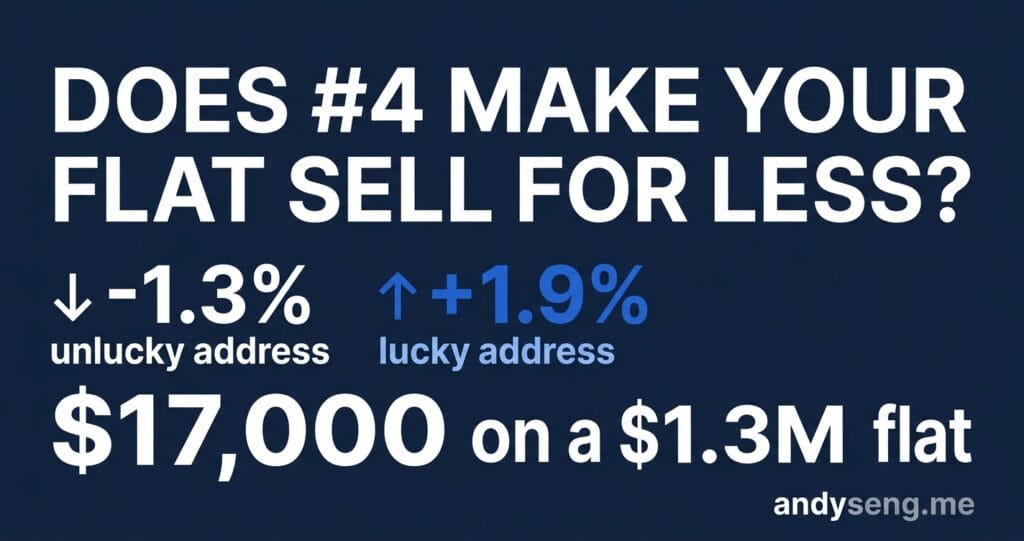
He, Liu, Sing, Song and Wong published “Superstition, Conspicuous Spending, and Housing Market: Evidence from Singapore” in Management Science in 2020. They went through real transaction data and found homes with unlucky addresses sold for about 1.3% less. Homes with lucky addresses sold for about 1.9% more. On inauspicious days on the lunar calendar, fewer people transacted at all.
Here’s the part most write-ups leave out: this effect wasn’t flat across the island. It showed up strongest in buildings where the buyer pool was mostly Chinese, concentrated enough that the belief was actually shared by the people bidding. Where that concentration was lower, the effect got weaker.
That detail matters more than the headline number. It suggests this isn’t simply about the digit 4. It’s about what happens to price when enough people looking at the same unit share a belief, and act on it.
Why superstition can become supply and demand
Play it forward. A unit with 4 in the address doesn’t have worse construction. It doesn’t lose usable space. But if a meaningful slice of your buyer pool crosses it off the list before they’ve even asked for a floor plan, your buyer pool just got smaller.
Smaller buyer pool, softer price. That’s not mysticism. That’s the market doing exactly what it always does.
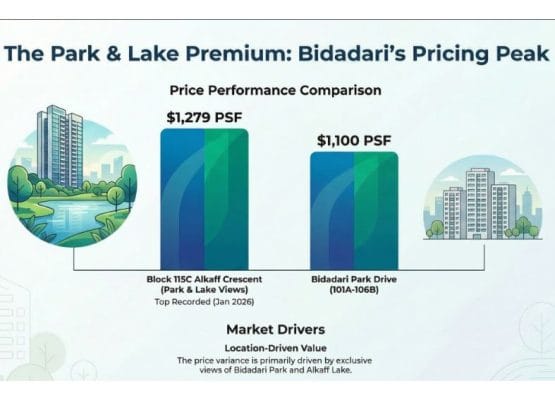
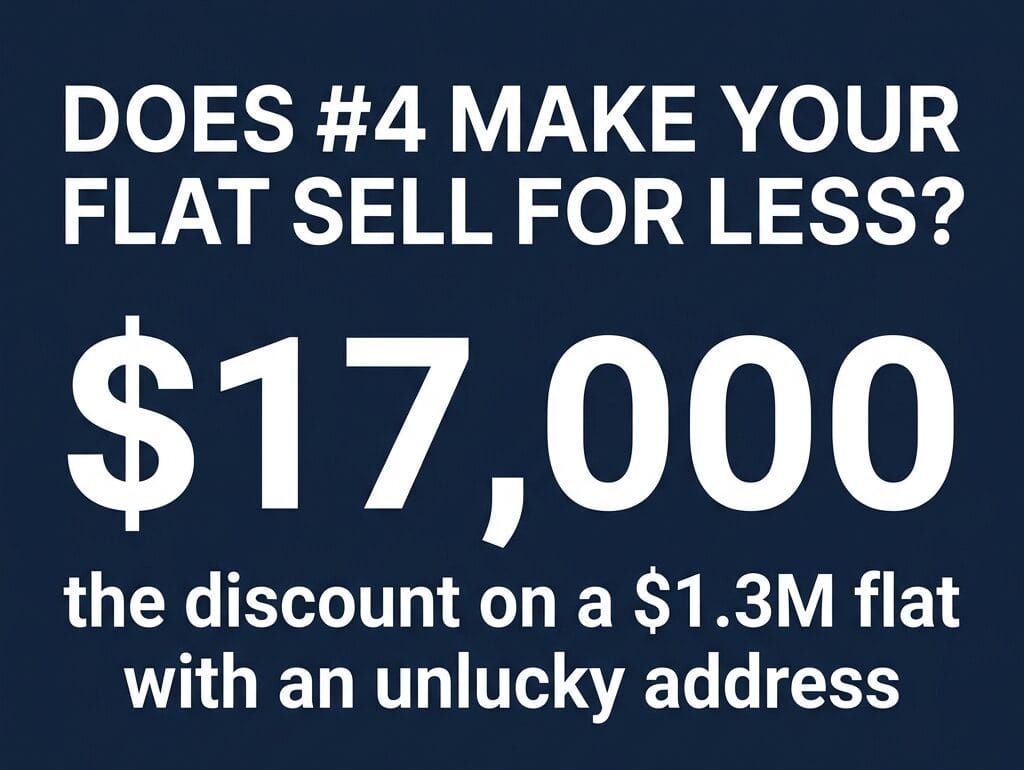
Put a number on that. Take a flat like the one that just changed hands at 115C Alkaff Crescent for $1,336,000, the block I wrote about last month. A 1.3% discount on a flat that size works out to around $17,000. A 1.9% premium is closer to $25,000. That’s not a rounding error sitting on a spreadsheet somewhere. That’s real money attached to an address.
The bottom line
If you’re selling a flat with a 4 in the floor or unit number, price it knowing your buyer pool is smaller than the identical unit next door. Not because anything is wrong with the flat, but because some buyers won’t even come to view it.
If you’re buying, that same smaller pool can work in your favour. Less competition on that specific stack usually means more room to negotiate.
Neither of those means you should chase the lucky number or run from the unlucky one. It means understanding who else is bidding against you, and just as importantly, who isn’t.
The lens for this whole series
Going forward, I’m not interested in whether a belief is “true.” That’s a question for a temple, not a spreadsheet.
The question I actually care about, the one that affects what you pay or what you walk away with, is simpler:
Does the belief change buyer behaviour enough to show up in the price?
Next stop: Bidadari. My own estate spent 65 years as a cemetery before it became one of the most talked-about postcodes in Singapore. If a single digit on a door can move price by more than 1%, what happens when the thing buyers might avoid isn’t a number, it’s the ground the whole block sits on? That’s what I’m digging into next.
If you’re eyeing a specific unit and want to know whether its address, floor, or history could be shrinking its buyer pool at resale, message me the address. I’ll pull the actual data with you.
Sources: He, Liu, Sing, Song & Wong, “Superstition, Conspicuous Spending, and Housing Market: Evidence from Singapore,” Management Science, 2020, Vol. 66, No. 2, pp. 783–804; National Heritage Board records on Bidadari Cemetery.